


Clothing in India – A BlenTraditional d of Culture, Tradition & Fashion
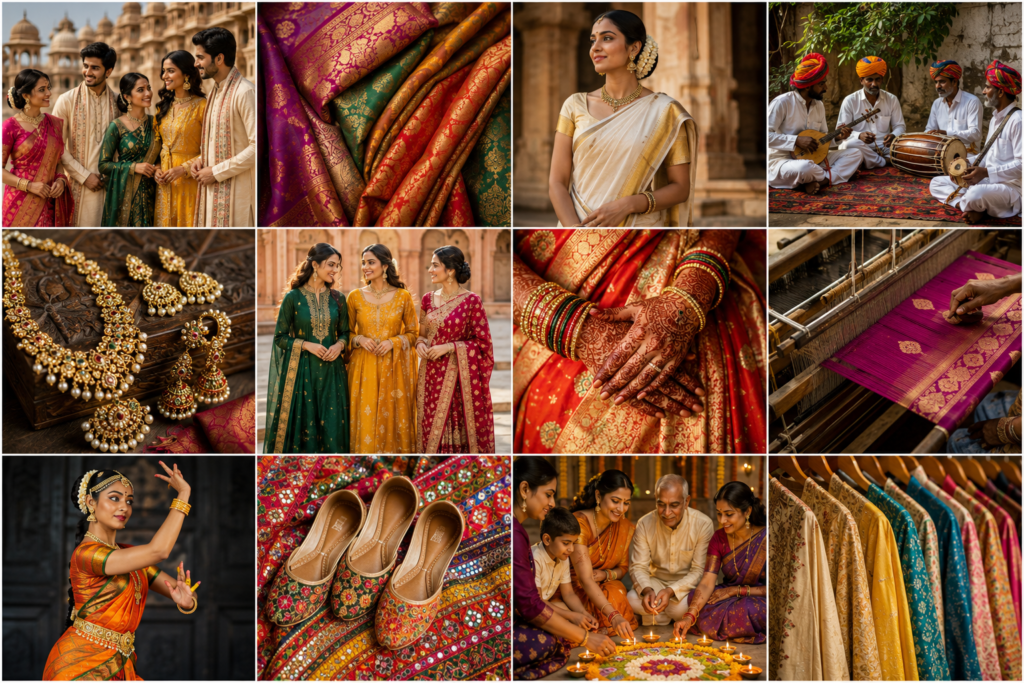
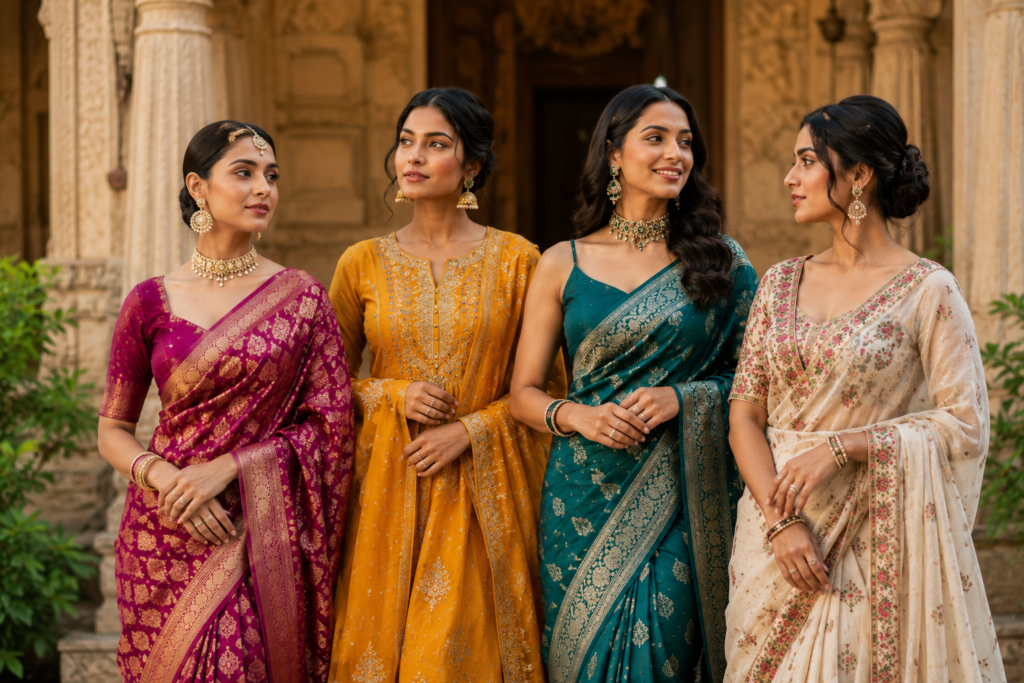
India doesn’t really have one fashion tradition. It has thirty-odd of them, layered on top of each other, region by region, occasion by occasion — and somehow they all work.
A Kanjeevaram silk saree from Tamil Nadu and a phulkari dupatta from Punjab look nothing alike, but both are traditional Indian clothing. That’s the thing about this country’s fashion: the range is absurd. Sarees, lehengas, kurtis, salwar suits, sherwanis — each one carries its own history, its own geography, its own reason for existing.
For daily wear, most people reach for something breathable and easy — a cotton kurti with churidar, a simple salwar suit, a block-print kurta over jeans. Festive wear is a different conversation entirely. That’s where the embroidery comes out, the silk gets chosen, the jewellery comes out of the box it’s been sitting in since the last wedding.
What keeps traditional ethnic dresses so enduring isn’t nostalgia (though there’s plenty of that too). They’re genuinely good clothes. Cut for the Indian climate, designed for Indian occasions — they keep getting updated with new silhouettes and fabrics and styling tricks, but the underlying logic stays the same.
Practical styling notes:
- Daytime events (think a pooja or a brunch) call for lighter ethnic wear. Pair a cotton kurti with minimal gold jewellery and you’re sorted without overdressing.
- Summer is cotton-kurti season. The fabric breathes, doesn’t cling, and looks put-together even when you’re not trying.
- For fusion looks, the easiest formula: traditional silhouette + modern accessory. An embroidered kurta with white sneakers, a handloom saree with chunky sunglasses, a lehenga skirt with a fitted tee. These aren’t new ideas anymore, which means they work.
Indian Wear for Women – Trending Styles for Modern Looks
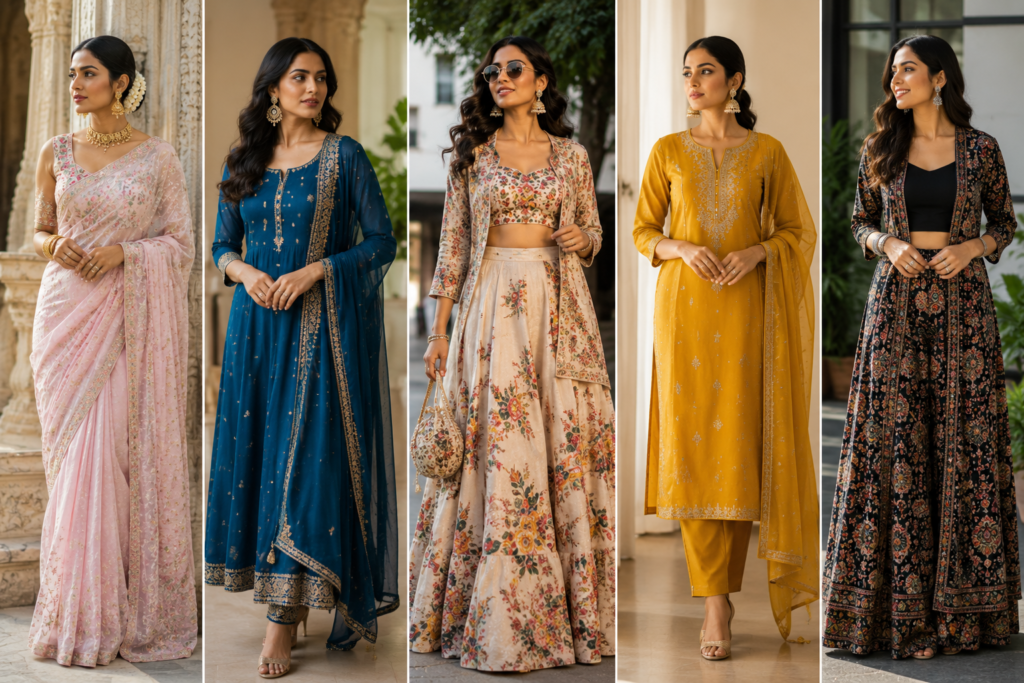
Something shifted in the last few years. Traditional wear stopped being a special-occasion-only category and started showing up everywhere — college fests, office parties, Sunday brunches, Instagram. Part of this is the fusion trend. Part of it is that the clothes just got better.
The crop top traditional pairing deserves its own mention because it works so consistently well. A printed crop top with a flared lehenga skirt for a festive function, a embroidered crop top with palazzo pants for a cocktail evening — these are easy outfits that photograph well and feel fresh without abandoning the ethnic aesthetic entirely. The key is proportion: if the top is cropped, the bottom should have some volume, and vice versa.
Sarees are in the middle of a styling revolution. Women are wearing them with shirts tucked in as the blouse, with chunky belts cinched at the waist, with sheer capes pinned at the shoulder. The drape itself has gotten creative (more on that in the saree section). But even a classic drape looks different now with the right blouse and the right shoes.
Kurtis have quietly become the most versatile piece in the Indian wardrobe. Long kurtis over cigarette pants for office. Short kurtis as tops over jeans for casual days. A-line kurtis for a kurta-style statement. And with the rise of designer kurti labels, even “casual” kurtis aren’t looking basic anymore.
Practical styling notes:
- Statement earrings do a lot of the work with crop top traditional outfits. Keep the neckline of the top relatively clean and let the earrings be the focus.
- The belt-on-saree trick is straightforward: drape as normal, then add a broad belt at the waist over the pleats. It holds the drape in place and creates a defined silhouette. Works especially well with georgette and chiffon sarees.
- Jackets and capes layered over lehengas are a good option for wedding guests who want to look special without outshining the bride. A nude organza cape over a jewel-toned lehenga hits that balance well.
Traditional Indian Wedding Clothes – Reception & Festive Glam
Wedding dressing in India is a sport. There are functions to account for (mehendi, sangeet, ceremony, reception — sometimes more), dress codes that vary by family and region, and the constant background pressure of looking good in someone else’s wedding photos.
The reception is the function that allows the most creative freedom. You’re not the bride. You don’t have to match the family. The brief is essentially: look great.
.
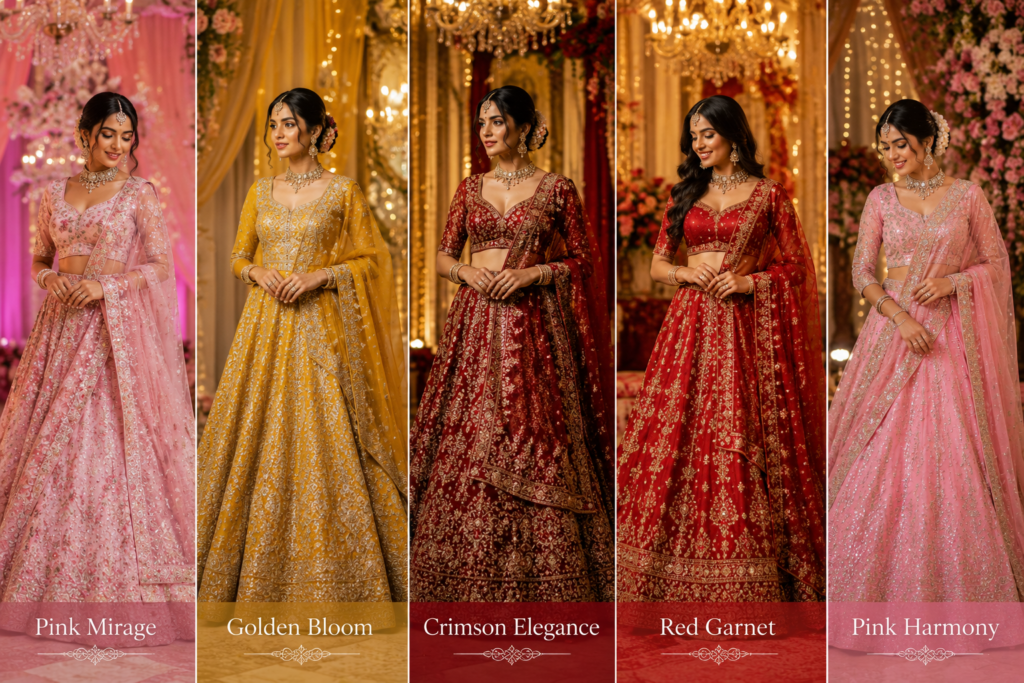
A few directions that actually work right now:
Pink Mirage — pastels with pearl jewellery. A blush pink organza saree or a pastel pink lehenga, styled with layered pearl necklaces and a soft makeup look. Understated but clearly deliberate.
Golden Bloom — gold base with heavy work and bold jewellery. A gold-toned tissue or banarasi outfit with polki or kundan jewellery. A classic that hasn’t aged because it’s never tried to be trendy.
Crimson Elegance — deep red in something structured. A red brocade suit with a stiff dupatta, or a red embroidered saree with a boat-neck blouse. This reads as sophisticated rather than bridal because of the structured silhouette.
Red Garnet — a different kind of red. Darker, more burgundy, paired with uncut diamond or antique gold jewellery. This is the option for someone who wants to be noticed without the theatrics.
Pink Harmony — mixing shades of pink across a single outfit. A rose-pink lehenga with a mauve blouse and a fuchsia dupatta, tied together with matching embroidery. It shouldn’t work and yet it does.
For fabrics: organza and satin do the most for reception looks. Organza gives structure without weight; satin has that drape that photographs beautifully. Both hold embroidery well.
Practical styling notes:
- Bold makeup and heavy jewellery together is usually too much. Pick one. If the outfit already has a lot going on, clean makeup and one statement piece (say, a choker or earrings) does more than doubling down on everything.
- Embroidered clutches and potli bags are the easy accessory answer for festive dressing. They match without being too matchy and carry enough for a wedding evening.
Quick question: What are popular reception looks for women? Saree gowns, heavily embellished lehengas, structured cape-style outfits, and draped skirts in organza or satin are what’s showing up at most receptions right now. Pastel suits with mirror work are gaining ground too.
Drape Diaries – Modern Saree Draping & Jewellery Pairing
The standard Nivi drape — saree tucked into the petticoat at the left, pallu thrown over the shoulder — is not the only option. It’s the easiest to learn and the most stable to wear, which is why it became the default. But once you’re comfortable with the basics, there’s a lot more the saree can do.
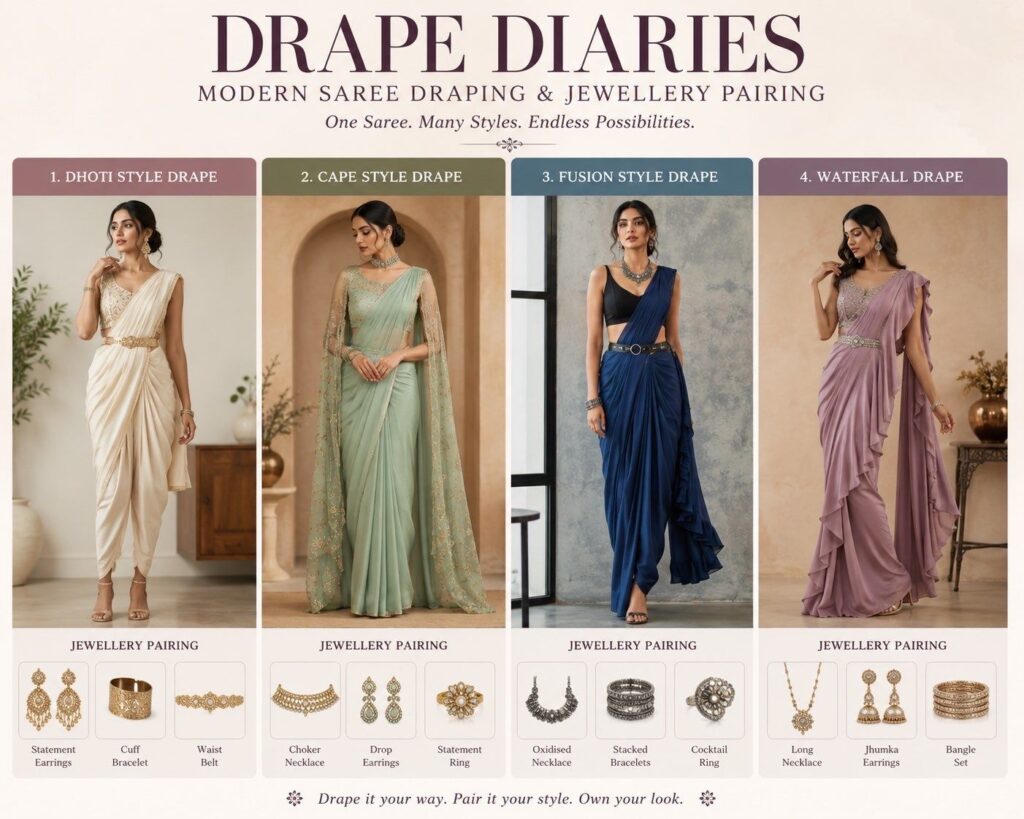
Dhoti Style — the pallu is brought around the front and tucked in between the legs to create a pant-like shape. It’s more comfortable to walk in than a standard drape and looks good at semi-formal occasions.
Cape Style Drape — a separate cape is worn over the blouse, with the saree draped beneath. The pallu can be minimal or even tucked away. This works at cocktail events and receptions when you want some visual interest at the top without a heavily worked blouse.
Fusion Style Drape — this is the category for everything experimental: sarees draped over belts, paired with shirts instead of blouses, worn with fitted pants peeking out at the bottom. There are no fixed rules; the idea is to keep the saree fabric as the statement and build around it.
Waterfall Drape — layers of the saree fabric are allowed to fall loosely at the front rather than being pleated neatly. It gives a more relaxed, modern silhouette and works well with sarees that have interesting borders.
Practical styling notes:As for jewellery — it really depends on the saree.
- A Bandhani saree has a lot happening already with the tie-dye pattern. Oxidised silver jewellery keeps the look earthy and doesn’t compete with the textile.
- A plain silk saree is asking for something elaborate: jhumkas, a layered necklace, a maang tikka.
- A chiffon or georgette saree, especially in a solid colour, is where you can have the most fun — pendant sets, statement bangles, a choker.
- If you’re learning to drape, start with chiffon or georgette. These fabrics are forgiving — they move easily, and a slightly imperfect pleat isn’t visible. Cotton sarees are stiffer and need more precise tucking.
- Cape drapes work best at receptions and cocktail events. They read as dressed-up rather than traditional, which is the right register for those functions.
- Lightweight sarees also stay cooler, which matters a lot at outdoor Indian weddings.
Quick question: Which fabric is easiest for beginners? Chiffon, georgette, and soft cotton. They’re lightweight, drape easily, and stay in place without needing to be pinned every five minutes.
Fabrics, Bags & Suit Neck Designs That Complete the Look
The fabric isn’t just a background detail. It’s the decision that determines whether the outfit reads as casual, festive, formal, or somewhere in between — before a single accessory is added.
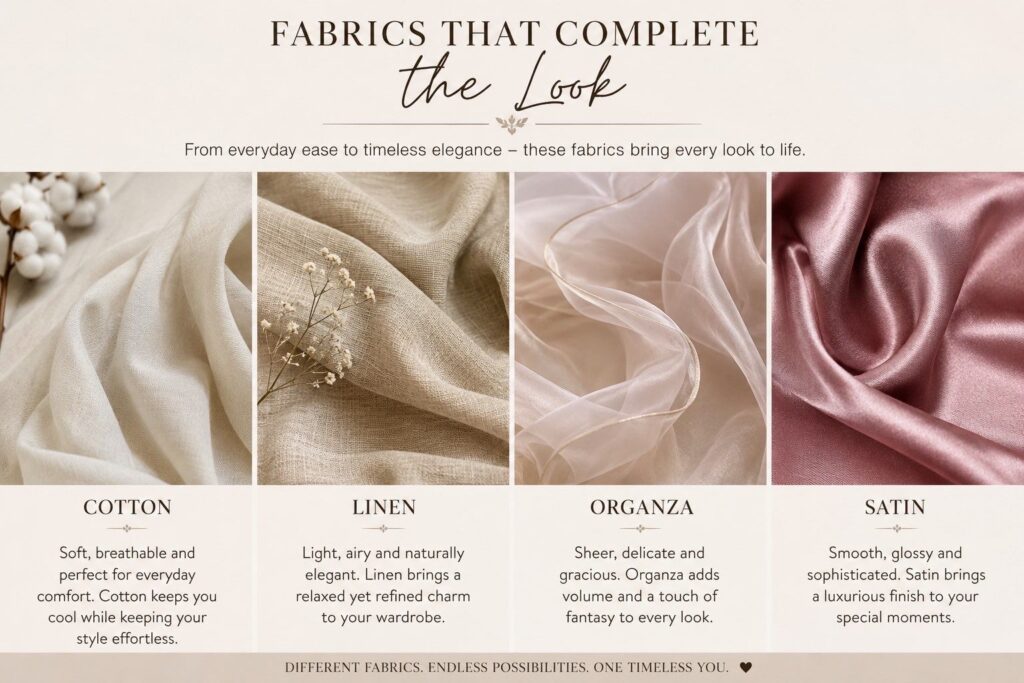
Cotton is the everyday foundation. Cool, washable, available in a thousand prints and weaves. A cotton kurti works for a morning meeting and a casual lunch. Not trying to be anything other than comfortable — which is exactly what daily wear should be.
Linen has a slightly more relaxed quality than cotton. Some texture, some looseness. Good for ethnic separates at lower-key outdoor events, the kind where you want to look put-together without sweating through your outfit by noon.
Organza is stiff and sheer and catches light in a way that reads as festive. A lot of wedding-adjacent sarees and dupattas are organza for exactly this reason. It photographs well and holds structure even in Delhi summer heat.
Satin has that drape and sheen that makes simple cuts look expensive. Reception outfits in satin get away with less embellishment because the fabric does most of the work on its own.
Bags in the ethnic space have gotten genuinely interesting.
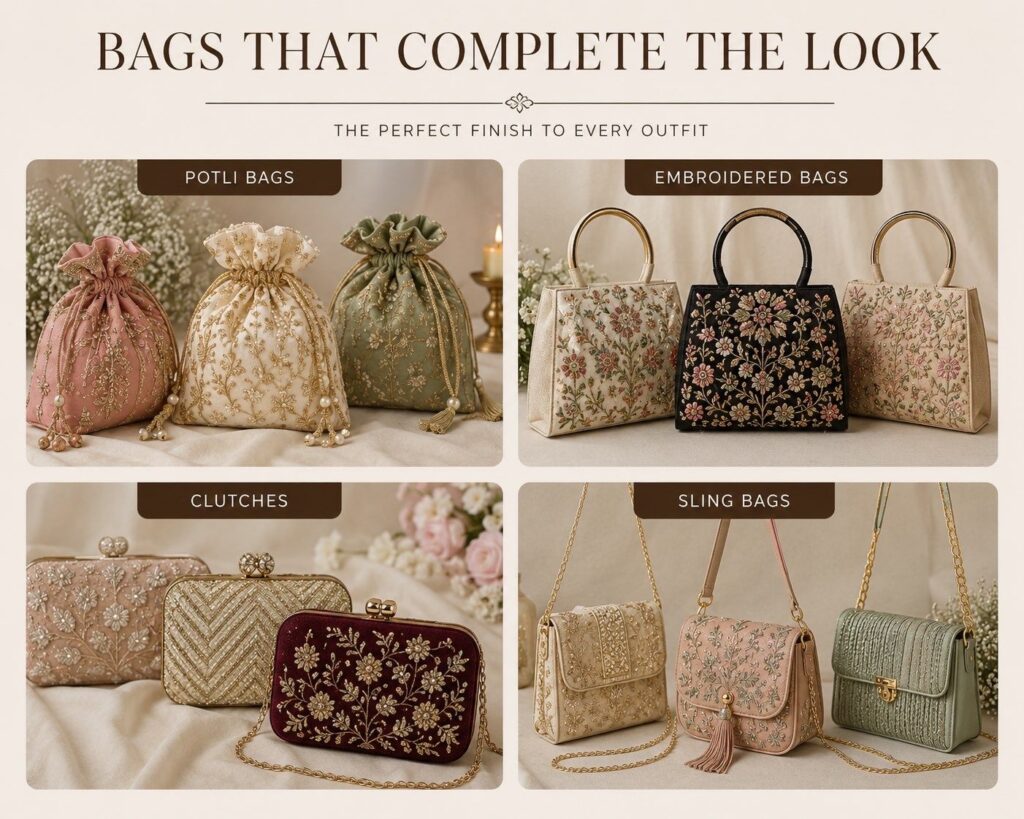
Potli bags — drawstring pouches, often embroidered or beaded — are the obvious choice with lehengas and sarees. They look intentional and come in every price range.
Embroidered bags — sometimes bigger than a potli, with more structure, often in zardozi or thread work. These can cross over to office or brunch use if the embroidery isn’t too heavily festive.
Clutches — the slim hard-case type, covered in mirror work or sequins, mostly for evening events. They don’t hold much but they’re not supposed to.
Sling bags — the option for when you want both hands free and some practicality. In a small, embroidered format, a sling bag doesn’t break the ethnic aesthetic.
Neck designs on suits and kurtis affect how the whole outfit reads, more than most people realise.
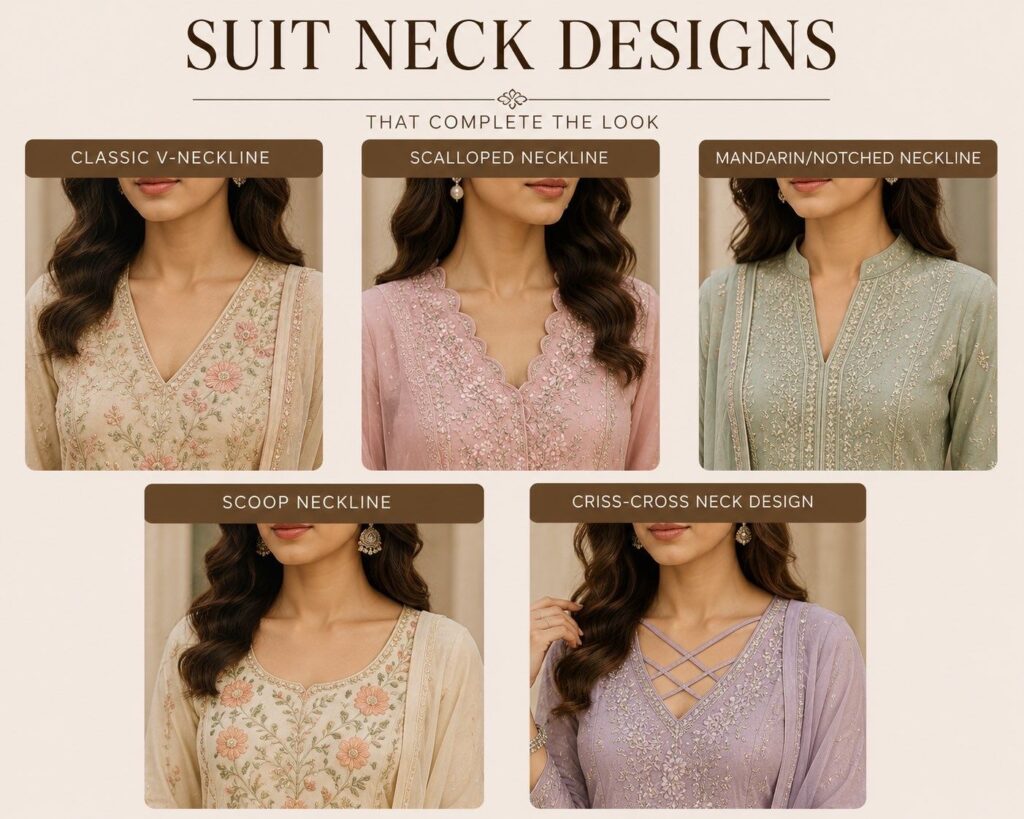
Classic V-neckline — elongates the neck, works on most body types, universally flattering. The low-effort, high-return option.
Scalloped neckline — delicate curved edges. Reads as feminine and slightly formal. Good on A-line and straight-cut suits.
Mandarin/Notched collar — the high standing collar, often seen on kurtas. It has a crispness that works for office and formal occasions.
Scoop neckline — similar to V but rounded. Comfortable, casual, works well for everyday kurtis.
Criss-cross neck design — overlapping fabric at the neckline, often with a tie. This is a more decorative choice, usually found in party-wear and festive suits.
Practical styling notes:
- Cotton kurtis for office: V-neck or scoop, clean print, minimal jewellery. Simple.
- Potli bags with sarees and lehengas are always the right answer for weddings. They don’t fight the outfit.
- If you’re unsure about jewellery, V-neck and scoop neck designs are the easiest to accessorise. They leave room at the neckline for a necklace without crowding anything.
FAQs
What are traditional clothes?
Traditional clothes are outfits that connect to a culture’s history and customs. In India, that means sarees, lehengas, kurtis, salwar suits, sherwanis, dhotis, and a long list of region-specific forms — a Kashmiri pheran, a Kerala mundu, a Gujarati chaniya choli. They’re not museum pieces; most of them are still worn regularly, updated slightly with each generation but recognisably themselves.
What are the best fabrics for women's traditional wear?
For daily wear: cotton and linen. They’re practical, breathable, and easy to maintain. For festive occasions: silk, organza, or satin. Chiffon and georgette work well for sarees specifically because they’re easy to drape. The short answer is that the right fabric depends on the occasion and the Indian climate, which does most of the deciding for you.
What is the difference between traditional wear and ethnic wear?
Traditional wear has a specific cultural or regional identity attached to it — a Benarasi saree, a Lucknowi chikankari kurta, a Rajasthani bandhani lehenga. Ethnic wear is broader: it covers traditional pieces and modern Indian-inspired fusion. A crop top with a lehenga skirt is ethnic wear, but it’s not traditional in the strict sense. Both terms get used loosely in practice, often interchangeably.
What jewellery goes well with traditional wear?
The broad answer: jhumkas and bangles go with almost everything. Beyond that, it’s about the fabric and occasion. Silk sarees and heavy lehengas can carry polki, kundan, or layered necklaces. Lighter cotton or linen outfits look better with oxidised silver or simple gold pieces. Chokers are good for sarees with lower necklines. Maang tikkas work for more dressed-up occasions — weddings, receptions, festive functions.
.
How can I style a saree in a modern way?
The straightforward options: add a belt at the waist over the pleats, experiment with a cape drape, try a dhoti-style tuck instead of the standard Nivi drape. For the blouse, off-shoulder cuts, sheer backs, and printed or contrasting fabrics all change how a saree reads. Footwear matters too — sneakers with a casual saree have become their own whole aesthetic. The saree is more flexible than it looks. Most of the “rules” are fairly optional.